Voilà des années que les tensions entre l’Ukraine et la Russie n’ont pas
été aussi fortes. Le stationnement massif de troupes russes à proximité des
frontières du pays fait craindre une invasion de la part de Moscou. La crise
actuelle a été provoquée par le renforcement constant du dispositif militaire
russe en Ukraine et dans les environs, ainsi que par l’utilisation
déstabilisatrice d’attaques hybrides, notamment de désinformation et de
cyberattaques, contre les institutions gouvernementales ukrainiennes.
La frénésie de négociations internationales de la semaine dernière n’ayant
débouché sur aucune avancée, la Russie semble se préparer à une nouvelle
agression contre l’Ukraine. Mais l’Union européenne (UE) est toujours en train
de calibrer sa réponse potentielle.
L’UEF fait la même évaluation que les institutions européennes de la
gravité de la situation et elle souhaite que les efforts diplomatiques soient
couronnés de succès. Nous sommes solidaires de l’Ukraine et de ses citoyens et
nous confirmons à nouveau notre soutien sans équivoque à la souveraineté et à
l’intégrité territoriale de l’Ukraine à l’intérieur de ses frontières internationalement
reconnues. L’Ukraine est un pays libre et souverain et l’UE doit continuer de
se tenir à ses côtés.
L’UE doit faire usage de sa principale force – l’influence économique – et
se préparer à le faire de manière stratégique pour parer à toutes les
éventualités. Il n’y a pas d’autre moyen pour l’Union de persuader les grandes
puissances qui se disputent l’avenir de l’Europe de ce qu’elle est une force
avec laquelle on doit compter. Nous devons continuer de soutenir les militaires
et les civils ukrainiens en leur fournissant les moyens de se préparer, allant
de l’énergie à la cybersécurité.
« L’UE n’est pas parvenue à
préparer un ensemble robuste de sanctions à imposer à la Russie pour le cas où
le pays envahirait à nouveau l’Ukraine. Ce ne sont là que de piètres excuses
pour justifier l’inaction. Une UE fédérale dont la politique étrangère ne serait
pas soumise à des menaces de veto individuelles serait plus efficace. Cette
nouvelle crise est l’occasion pour l’UE d’être plus mûre, plus souveraine et
plus indépendante et de devenir un acteur mondial indépendant, qui agit
rapidement et vigoureusement chaque fois qu’une crise éclate, avec des
partenaires si c’est possible mais seul si nécessaire. Nous attendons avec
impatience le nouveau document de la boussole stratégique de l’UE – dont le
besoin est aujourd’hui plus urgent que jamais – et un suivi des conclusions de
la conférence sur l’avenir de l’Europe qui pourrait conduire à une UE plus
démocratique, plus souveraine et plus forte dans le monde » déclare Sandro
GOZI, président de l’UEF et député européen, en appelant à une amélioration
déterminée de la politique étrangère, de sécurité et de défense de l’UE.
« Nous devons nous appuyer sur la diplomatie
pour parvenir à un accord qui profite à toutes les parties impliquées dans ce
conflit, y compris l’UE. Nous avons besoin d’une politique étrangère pour
gagner en engageant les États-Unis, la Russie et l’Ukraine à débloquer les
négociations »
conclut M. GOZI.
Nous considérons que l’avenir du peuple ukrainien et celui des autres pays
du Partenariat oriental, ainsi que celui de la Russie, se trouve en Europe.
Nous sommes convaincus qu’il existe un avenir radieux pour l’Ukraine et son
peuple.
Contexte
La fin de la Seconde Guerre
mondiale a entraîné un nouvel ordre fondé sur la confrontation de deux grands
blocs. Le bloc occidental s’était organisé militairement autour de l’OTAN
(1949) et, en réponse, l’URSS avait promu le Pacte de Varsovie (1955).
L’Ukraine faisait partie de cet accord en tant que république soviétique au
sein du bloc de l’Est.
En 1991, l’Union soviétique a été dissoute et les quinze républiques ont déclaré leur indépendance. L’Ukraine compte une importante minorité russophone, très présente dans l’est du pays et dans la péninsule de Crimée. Comme la Russie, l’Ukraine a connu dans les années 1990 une profonde dépression économique. L’effondrement de l’URSS a permis à l’OTAN d’étendre son influence en Europe de l’Est. Cette expansion inquiétait Moscou, qui ne put cependant l’éviter. La décennie des années 2000 a été turbulente pour l’Ukraine, le pays étant contrôlé par des oligarques proches de Moscou, dont les politiques répressives du gouvernement ont ralenti la modernisation et a conduit à la révolution orange et à la révolution « Euromaidan ». Avec les derniers gouvernements, certaines réformes pro-européennes ont provoqué des protestations en Crimée, où la majorité de la population est pro-russe. La Russie a profité de la situation et a envahi la péninsule de Crimée, sur la mer Noire. L’Europe a imposé des sanctions économiques à la Russie. Dans le même temps, des affrontements armés ont commencé dans le Dombass, mais le conflit est resté gelé jusqu’à aujourd’hui.
Tensions between Ukraine and Russia are at their highest in years, with a Russian troop build-up near the two nations’ borders spurring fears that Moscow could launch an invasion. The current crisis has been provoked by an ongoing Russian military build-up in and around Ukraine, as well as the destabilising use of hybrid attacks, including disinformation and cyber-attacks, on Ukrainian government institutions.
This week, EU Member States have given their political agreement for a new package of sanctions against Russia, after Putin’s decision to recognise the Ukrainian regions of Donetsk and Luhansk and sending troops to these areas. This decision violates the territorial integrity and sovereignty of Ukraine. Russia is not respecting its international obligations, and it is violating core principles of international law.
UEF welcomes the EU’s package of sanctions. We stand with Ukraine and its citizens and reaffirm unequivocal support to Ukraine’s sovereignty and territorial integrity within its internationally recognised borders. Ukraine is a free and sovereign country and the EU must continue to stand by its side.
We must act on a double track: the first one, the one related to the urgency, to respond with sanctions to Putin and pursue the diplomatic option. If the EU pursues and increases the sanctions, a compensation mechanism must be created in favour of the affected EU firms.
At the same time, in parallel, we must take steps forward on the military and energy autonomy of Europe. A federal EU whose foreign policy was not subject to individual veto threats would be more effective. This new crisis is an opportunity for the EU to become more mature, sovereign and an independent global actor, who act rapidly and robustly whenever a crisis erupts, with partners if possible and alone when necessary. We are eagerly awaiting the EU’s new Strategic Compass document – now needed more urgently than ever – and a follow up on the Conference on the Future of Europe conclusions that might lead to a more democratic, sovereign and stronger EU in the world.
The Conference on the Future of Europe (CoFoE) has entered its hot political phase and I want to express my appreciation for your dedication and commitment.
Being present in a structured and effective way, as well as being recognisable on the CoFoE Multilingual Digital Platform with our proposals, became a necessary condition both for conveying its political message and for enhancing meetings on the ground at all levels. The aim was to be influential in order to condition future decision-making processes, to bring out the drive for reform of the European Treaties, unavoidable if it emerged from the debate and the requests of citizens, on the platform – the only tool at our disposal to convey ideas and political message. From there, we, federalists, conveyed both to the European citizens’ panels and, above all, to the plenary session.
With a view to a debate aiming at advancing federalist demands, we encouraged our Sections and Members to organise debates linked to our political proposals on the platform. For nearly a year, you have been boosting your efforts to raise awareness about this positive momentum, with a view to engage citizens directly, and to gain wider support for our ideas, projects, and proposals. Therefore, I wish to thank you for crowding the squares of your cities and towns, for organising conferences and workshops in schools, universities, and inside your sections.
During this past year, we have seen enormous growth in the support and visibility of federalist ideas, especially those aimed at strengthening European Democracy. You have been integral to the important advances we have made, particularly promoting a stronger pan-European democracy — real European political parties and movements and proper campaigns for European elections, based on the creation of a pan-European constituency and transnational electoral lists headed by the candidates for President of the European Commission. Moreover, we have also called for the need for a political and fiscal Union that can tackle the great transnational challenges of our time, acting decisively on a wide range of policy areas, from climate change, growing social inequalities, health and migration to foreign affairs and defense.
Our collective efforts together with JEF and the Spinelli Group, yielded a great outcome for the federalist ideas in the CoFoE Multilingual Digital Platform. This was only possible through your commitment of time and effort, which was especially notable during this final rush campaigning together for a more sovereign, democratic and federal Europe.Again, I would like to thank you for all your invaluable contributions and your continued commitment to the federalist values and mission of our organisation. Yours faithfully,
“Make sure your voice is heard. Never wait for somebody else to talk for you. You have a voice that can be as loud and the integrity of your argument can matter.” – Roberta Metsola, EP President
THE TIME IS NOW, UEF’s fortnightly newsletter on the Conference on the Future of Europe! Issue 3/2022
Learn more about the Conference’s latest news and activities related to rebuilding the EU!
PANEL RECOMMENDATIONS ON EU IN THE WORLD AND MIGRATION
The final meeting of the fourth European Citizens’ Panel took place on 11-13 February 2022 in Maastricht, the Netherlands.
On Sunday, the European Citizens’ Panel on ‘EU in the world / Migration’ voted through its 40 recommendations for the Conference on the Future of Europe (CoFoE). The Panel worked around five work streams: self-reliance and stability; the EU as an international partner; a strong EU in a peaceful world; migration from a human perspective; and responsibility and solidarity across the EU. The Panellists’ recommendations stem from their previous work carried out during two sessions, held in Strasbourg on 15-17 October 2021 and online on 26-28 November.
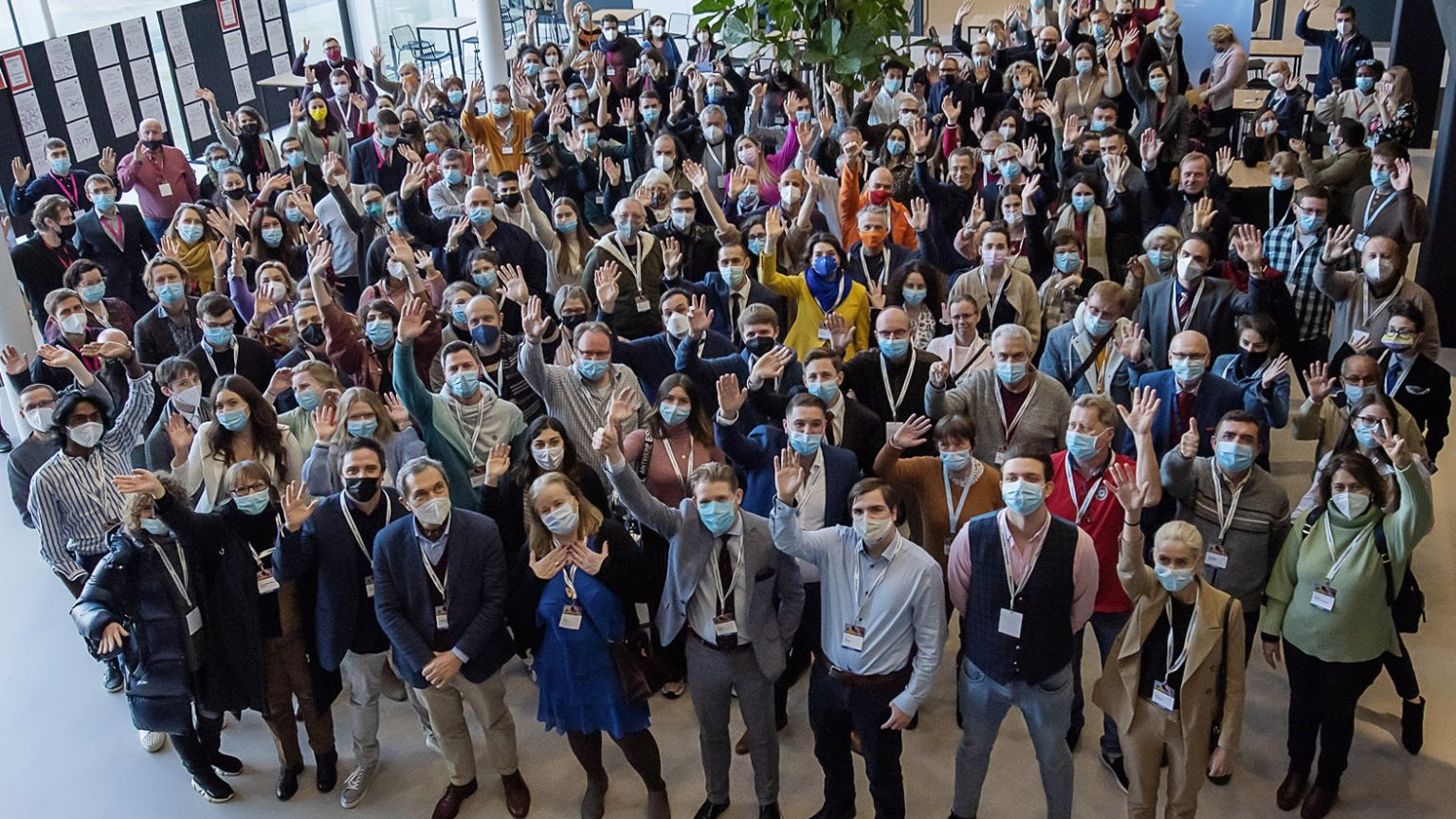
The third and final meeting of the Panel, comprising around 200 people of different ages and backgrounds, from all Member States, was hosted by the European Institute of Public Administration in Maastricht and Studio Europa Maastricht.
Source: Multimedia Center, European Parliament
Migration
After exchanging views on all aspects of migration, panellists recommended measures to address its causes and regulate it in a humanitarian way, to better integrate refugees and to share responsibilities among all EU countries.
Participants noted that migration is not necessarily a problem. They proposed giving access to the European labour market to asylum seekers with relevant qualifications and improving conditions for workers migrating within the EU.
Inequalities along external EU borders were also highlighted. To address that, participants recommended that the European border agency Frontex is reinforced and made more transparent.
The EU in the world
The EU’s dependence on imports of strategic goods, such as medicines, semiconductors, energy and food, was a major concern. The panel recommended better support for local production and increasing the output of renewable energy in order to reduce dependency “to the largest possible extent”.
It also proposed that most decisions in the field of foreign affairs be taken by qualified majority instead of unanimity to speed up responses to crises and to consolidate the EU’s presence in the world through a united front.
The EU should also apply restrictions to imports from countries that don’t comply with ethical or environmental criteria and promote values like human rights and democracy abroad, panellists recommended.
METSOLA: “MAKE SURE YOUR VOICE IS HEARD”
Parliament President Roberta Metsola answered questions live on social media about health, climate change and inequality
Engaging young people in the future of the EU
As only the third woman to lead the European Parliament, President Metsola said she is grateful to the women who came before her for breaking barriers. Her advice to young girls is: “Make sure your voice is heard. Never wait for somebody else to talk for you. You have a voice that can be as loud and the integrity of your argument can matter.”
She invited young people to express their ideas on Europe by participating in the CoFoE. “Send your messages, we will listen to them. It’s our responsibility, because in 2024 I need to convince [everyone], together with my colleagues here, that this place is worth keeping, because we are working for you,” she said, referring to the European elections.
Strengthening Parliament’s role in the EU
Metsola said Parliament has a “golden opportunity” to transform into a modern, effective and efficient institution and to draw lessons from the pandemic. She stressed Parliament wants the power to propose new laws, because Europeans want it to do more as the only directly-elected EU institution. “Let’s make sure we don’t hide behind political inability or unwillingness by saying there is no solution.”
MATTARELLA AND THE FUTURE OF EUROPE
President Sergio Mattarella, who was just re-elected for a second mandate, pro-European sentiments have recently been witnessed during a ceremony on the island of Ventotene in August where: he paid homage to the grave of Altiero Spinelli (co-author of the Ventotene Manifesto), who was in confinement on the island during the fascist regime.
Mattarella also endorsed the CoFoE. This deliberative democracy experiment “cannot be a grey passage with no historical vision, but must be an opportunity to define, with courage, a Union that is a protagonist in the international community,” the president said.
THE MAASTRICHT TREATY ANNIVERSARY
In 1984, the European Parliament adopted the draft of a European Constitution, which could still solve problems the EU faces today: nearly completely abolishing national vetoes, deciding the EU budget by Parliament and Council together, the EU court checking member states on questions of human rights and the rule of law, health and other societal policies to be a shared competence between EU and member states.
This courageous move 38 years ago is a wake-up call to pro-Europeans while the CoFoE is entering into its decision-making phase.
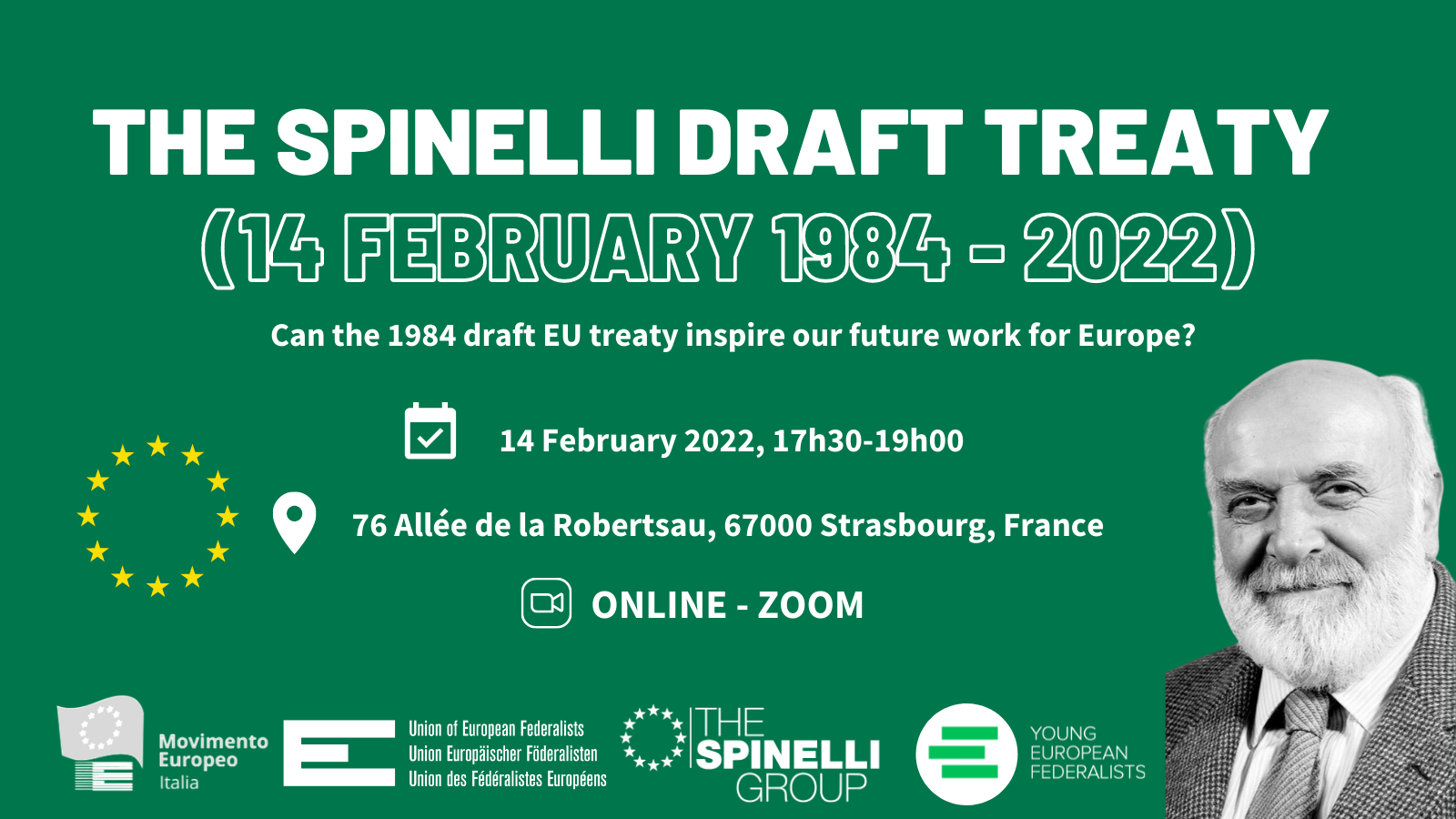
On 14 February, UEF, the Spinelli Group, JEF Europe and Movimento Europeo Italia organised an event to commemorate the Spinelli Draft Treaty’s approval by the European Parliament in 1984. We counted with current MEPs and renowned witnesses to explain the key features of the so-called Spinelli Project and how it can still inspire the future of Europe today.
Find here the full statement and here you can rewatch the discussion.
EUROPEAN PARLIAMENT DELEGATION TO THE COFOE
On 9 February, the parliamentary delegations to CoFoE had their first joint debate, focusing on European democracy and EU decision-making.
The European Parliament hosted the first joint meeting of EU and national parliamentarians participating in the CoFoE. The purpose of the meeting is to foster closer collaboration between MEPs and MPs, and to take stock of the recent Conference Plenary session that considered the recommendations from two European Citizens’ Panels and National Panels.
Strengthening European democracy
The first part of the meeting, chaired by Pieyre-Alexandre Anglade of the French National Assembly, focused on the legislative powers and democratic control exercised by parliaments, European elections, and EU decision-making. Most speakers agreed that, as the directly elected representatives of European citizens at national and EU level, MEPs and MPs share a responsibility to safeguard all democratic processes within the EU. Many spoke of the need to draw lessons from the application of the Maastricht and Lisbon Treaties, and to reform the EU to deal with challenges old and new.
In this vein, many supported Parliament’s call for a full right of legislative initiative. Others focused on the opportunity to establish transnational lists in European elections, debated proposals to directly elect the President of the Commission, and spoke on reforming the institutional roles of the Council and the Commission. Moving away from unanimity in the Council was proposed by many MEPs and MPs alike, as well as enhancing the role of national parliaments in the EU legislative process – with ideas for a revamped “green/yellow/red card” system for subsidiarity checks. Transparency in EU decision-making was another key point, with some speakers stating that citizens need to be able to know who among EU and member states’ institutions decides what. A few speakers took the floor to argue that the EU’s competences should be rolled back, calling for less European integration.
The EU’s role in the world and economic priorities
The second item on the agenda (chaired by Jean-François Rapin from the French Senate) included a debate on the EU Common Foreign, Security and Defence Policy, and on economic governance and the EU budget. Speakers focused on a broad range of issues. However, the common denominator for most of them was the need to tackle challenges posed by third countries, whether close to the EU’s border or in the international scene, through more efficient decision-making and effective coordinated action. Ideas brought to the table include moving away from unanimity in the Council, closer and more long-term alignment of economic and industrial policies, fostering strategic autonomy across multiple key sectors, and reviewing the role of the High Representative of the Union.
Citizens’ participation in democratic processes
The final debate, chaired by Parliament’s Co-Chair of the Executive Board of the Conference Guy Verhofstadt, was on the introduction of a permanent EU mechanism for citizens’ participation and consultation. Speakers took the floor to discuss lessons from the CoFoE’s structures and ideas like establishing a permanent online agora for EU citizens, a periodic consultation mechanism, and an obligatory “jury duty”-style call for citizens to engage in an EU-wide consultation process. Some speakers debated the appropriate balance between participatory processes and democratic representation.
Eighty Panel representatives (20 from each of the four Panels, of which at least one-third is aged between 16 and 25 years) have been tasked with presenting and debating the recommendations of all Panels at the Conference Plenary, where the CoFoE’s final proposals will be shaped. The next Conference Plenary is set to take place 11-12 March in Strasbourg.
There will therefore be four plenaries (two in March, and two in April, all in Strasbourg), as well as the concluding event to be held on 9 May.
The three Presidents of the CoFoE will make a common political declaration, to be prepared by the three Co-Chairs, at the concluding event on 9 May. Thereafter, the three Institutions should ensure an appropriate follow-up, with a GAC discussion, an EP resolution in June, at the European Council in June, as well as in the Commission’s State of the Union debate and legislative programme in September. The final report of the CoFoE should be concluded by the end of this year/beginning of next year.
Therefore, the four plenaries will focus on:
10-12 March I: discussions on recommendations from Panel 1 (Dublin) and Panel 4 (Maastricht)
24-26 March II: Presentation and discussion of the WGs’ draft proposals
7-9 April I: Presentation and discussion of the WGs’ draft proposals
28-30 April II: Plenary to adopt the CoFoE proposals
9 May concluding event (preceded by a social event/dinner on 8 May): Presentation by the three Presidents and the three co-Chairs
In the meantime, and up until 20 February, citizens across Europe can also continue to take part in the CoFoE through the multilingual digital platform.
Hope for EU treaty reform springs eternal. Frustrated with the current state of affairs, the number of governments clamouring for the introduction of QMV in Council decision-making on CFSP matters has been growing. Perhaps the outcomes of the upcoming French and Hungarian elections, or indeed that other CoFoE, will tip the balance and lead to an alignment of European stars.
Professor Kalypso Nicolaïdis (Chair in global affairs at the European University Institute in Florence) said that CoFoE, stakeholders have done the best they can do, but to make it a permanent exercise within the EU, there needs to be room for constructive criticism.
Proposal from the FMA to the CoFoE. The aim of this proposal, is to achieve a broad consensus within the FMA and its Reflection Group on the Future of Europe for a contribution to the plenary session of the CoFoE.
Citizens contributing to the CoFoE, the EU’s democracy engagement project, have made recommendations to widen the rule of law across member states, following views that there is a systemic conflictual climate between Poland and the EU.
The CoFoE is the first example of the systematic and structured involvement of EU citizens in shaping future policies that will significantly impact and shape our lives and the lives of future generations. We entered this process determined in the desire for the result to be a reform of the union that will reflect the wishes and demands of the citizens.
Une armée commune européenne est la condition sine qua non pour défendre les intérêts de l’Europe au-delà de sa politique commerciale et de son soft power.
MAKE SURE FEDERALIST VOICES ARE HEARD BY 20 FEBRUARY!
Brussels, 8 February 2022
Dear federalist friends,
About to conclude, the Conference on the Future of Europe (CoFoE) enters its hot political phase.
Three interim reports on the multilingual digital platform have been prepared so far, since the Platform kicked off in April 2021, and have fed into the work of the European and national Citizens’ Panels and the Conference Plenaries.
Only contributions made on the platform by 20 February will be taken into account in the report which will be published on 17 March.
We must make sure federalist voices are heard, and the time to act is now. We kindly ask you to boost our efforts to raise awareness about this positive momentum, with a view to engage citizens directly, and to gain wider support for our ideas, projects, and proposals.
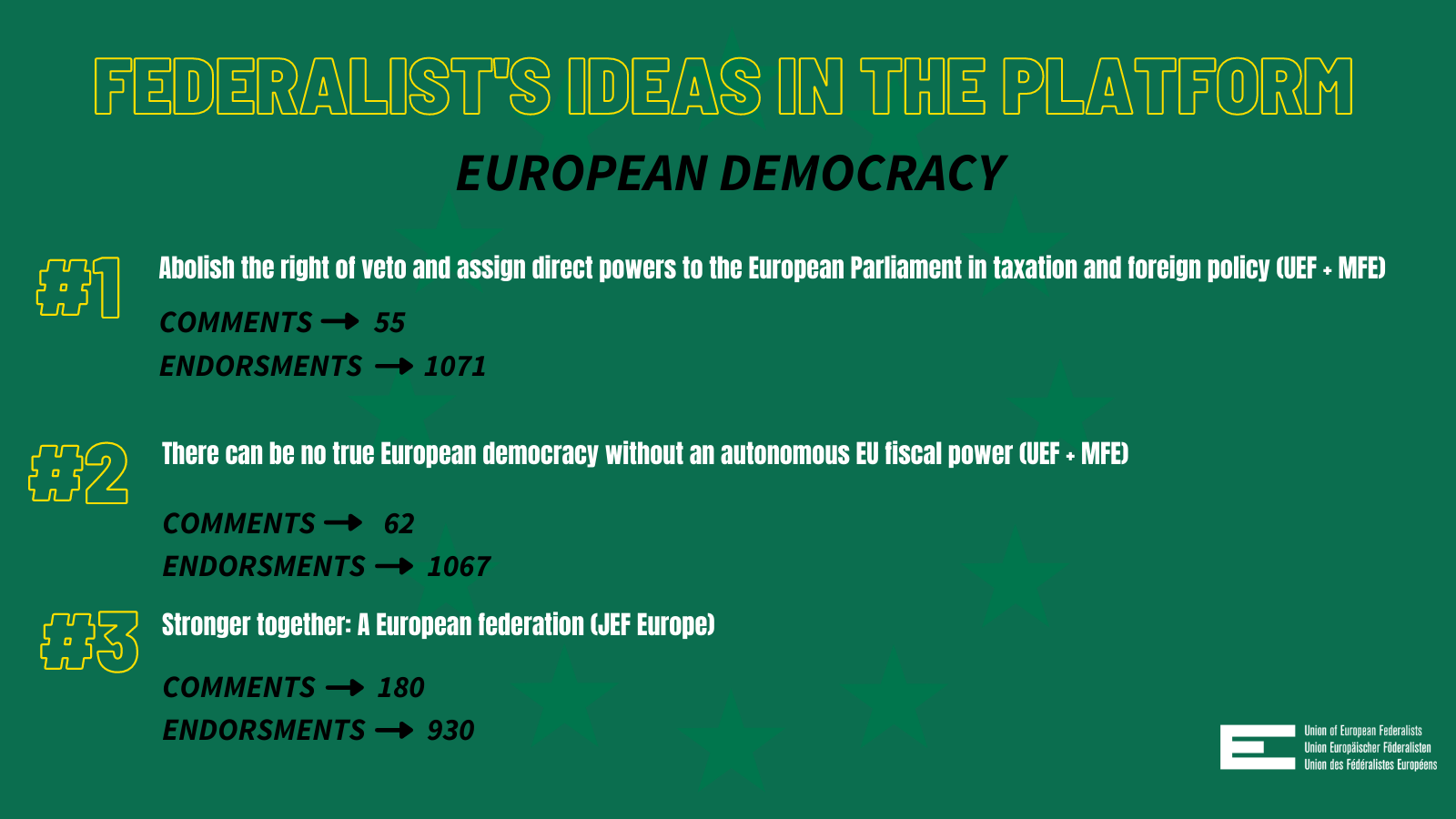
We therefore, invite you to refer to our ideas published on the Conference platform, that you can support and disseminate:
We must now take advantage of the Conference on the Future of Europe to move forward a more sovereign, democratic and stronger EU. As stated in the last line of the Ventotene Manifesto, the road won’t be easy, but we must strive to develop Spinelli’s ideas.
Find here a handbook on the CoFoE Multilingual Digital Platform.
In addition to that, if you wish to upload – last minute – your own positions or events and if you need support, please let us know!
“We should ensure politics serve citizens, this is the greatest contribution we can make for a better Europe. A follow up on their demands is the best way to pay homage to a great European and a friend, David Sassoli.” – UEF President and MEP Sandro GOZI
THE TIME IS NOW, UEF’s fortnightly newsletter on the Conference on the Future of Europe! Issue 2/2022
Learn more about the Conference’s latest news and activities related to rebuilding the EU! SIGN UP
3rd COFOE PLENARY
On 21-22 January, the 2rd Plenary of the CoFoE took place in Strasbourg. About to conclude, the process enters its hot political phase. The Conference Plenary discussed citizens’ recommendations and ultimately will transform them into the initiative’s outcome. The debates revolved primarily around the 90 recommendations by the Panels on ‘European democracy / Values and rights, rule of law, security’ and ‘Climate change, environment / Health’, and related recommendations from National Citizens’ Panels. The Panel on ‘European democracy / Values and rights, rule of law, security’ adopted 39 recommendations at its final session hosted by the European University Institute in Florence (Italy) in December. The Panel on ‘Climate change, environment / Health’ was hosted by the College of Europe in Natolin and the City of Warsaw (Poland) in January, where it finalised 51 recommendations within its remit.
Among the reccomendations of the citizens was the introduction of transnational lists in the elections to the European Parliament, composed of candidates from different Member States and which could be voted on throughout the EU. Due to the current debate in European Parliament this recommendation became very much the center of the debate not at least by the CoFoE-MEPs.
The citizens also recommend overcoming unanimity in the Council to approve certain measures and to give more powers to the European Parliament such as the legislative initiative.
They are also in favor of reopening the debate on the European Constitution and changing the names of the EU institutions to clarify their functions.
Despite an interesting agenda, some of citizens who took part expressed their impression that the politicians were not really interested in following up recommendations fairly or concretely.
During lively discussions, panellists asked for “detailed and timely” feedback from politicians on all the panels’ recommendations. Sebastián GUILLÉN, a participant from Spain, warned that Europeans “don’t want you to be telling us you will do something that you will actually never do”.
“We were given a voice, we were listened to. Now, we need solutions, not excuses. Let’s work together to ensure future generations will be proud of us, not ashamed,” said Dorin HELL, from Germany.
Following the event, Conference co-chair Guy VERHOFSTADT said he was “struck by how confidently citizens defended their recommendations, if necessary even against experienced politicians”. “It’s based on these recommendations that we need to formulate proposals and conclusions for the Conference,” he said when opening the plenary.
Conference co-chair Dubravka ŠUICA assured participants that “there’s no reason to doubt” that their calls will be heard.
Participating MEPs and members of national parliaments praised the “constructive” contributions from citizens and said they have the potential to “bring real change” to the EU.
UEF IN THE PLENARY
The Union of European Federalists (UEF) was represented in the Plenary of the CoFoE with our President and MEP Sandro GOZI, Vice-President and MEP Domènec RUIZ DEVESA and UEF Secretary General Anna ECHTERHOFF as part of the EMI Delegation to the CoFoE.
In the European Democracy Working Group, Sandro GOZI and Domènec RUIZ DEVESA emphasized the fact that citizens are reopening the debate for a future European Constitution. Citizens requested to build a stronger link between them and the European democracy, and the federalist MEPs explained to them different ways to achieve that goal – by electing directly the president of the European Commission, voting for transnational lists with European parties, giving full powers to the European Parliament and with annual citizens assemblies.
In prepartion of the Working Group Meeting, the UEF had been asked by the Chair of the Working Group, Manfred WEBER (MEP, Chair of EPP Group), to introduce the discussion of the agenda item “Citizens’ participation and youth” with a report. In view of the lively and intensive debate on many points already during the presentation of the Citizens’ Recommendations, the Working Group decided on spontaneous proposal of the Chair to deal with this agenda item, which was actually further down on the agenda of the Working Group, directly afterwards. By this the really good exchange that emerged was not interrupted.
In her presentation, the Secretary General of UEF, Anna ECHTERHOFF, then referred to the previous debate and the Citizens’ Recommendations and presented the perspective of the Union of European Federalists in her report. The top priority of the recommendations for reform would need to be the strengthening of European democracy. To achieve this objective, a real step towards a political union is needed. “This will require treaty change, which is already supported by some member states. And in line with the citizens’ recommendations No. 35 agreed in Florence, we should aim at a European Constitution. A European Constitution is necessary to adopt some of the reform proposals discussed in our conference. It is also the chance to simplify the EU’s institutional structure – a request expressed by many citizens. And a new constitutional process is a chance to engage more citizens in European politics”, said the UEF Secretary General.
With regard to the recommendations of the citizens, many similarities with the positions of the UEF could be found. These include, for example, the adoption of a new “electoral law for the European Parliament, harmonising electoral conditions” and complementing it with the “Spitzenkandidaten-Prozess”. She also stressed the importance of giving the European Parliament more powers in shaping EU policy (foreign policy, budget, taxation, …) and overcoming the frequent blockade in the Council.
In the Spinelli Group Caucus meeting, MEPs launched a new push for an EU constitution, arguing that EU leaders should heed the recommendations of the first citizens’ panel in the Conference on the Future of Europe. “We want a stronger Europe, more democratic, more reflective of daily needs of people, more ready to act and this requires changes to the current treaties,” says their declaration. The MEPs argue that following the French presidential election, there will be “a window of opportunity” for such ambitious reforms.
During the Conference Plenary, our representatives had the opportunity to discuss with the citizens’ on their proposals:
The main goal of this conference is to give voice to European democracy and experience it more directly, explained UEF President and MEP Sandro GOZI. In his speech, the UEF President encouraged his colleagues to build a real European political public space, directly voting for European political parties. Citizens would like to elect at least half of the members of the European Parliament through transnational lists, and we must follow up on their petition, added him in regards with the citizens recommendation.
“We should ensure politics serve citizens, this is the greatest contribution we can make for a better Europe. A follow up on their demands is the best way to pay homage to a great European and a friend, David Sassoli.”, concluded Sandro GOZI during the Plenary.
“Citizens are asking for transnational political parties with representatives from different member states. In the EP we are working on reforming the European electoral law, guaranteeing geographical and population balance when drawing up the lists.”, mentioned Domènec RUIZ DEVESA.
“We are at a watershed moment in Europe. We must work together, spare no effort and use all means at our disposal, to make the Conference recommendations a reality.”, added the Secretary General of EMI Petros FASSOULAS.
EU FRENCH PRESIDENCY
The 2022 French Presidency of the EU Council is set to go down in history as a moment of truth for the bloc. As such, it could mark the beginning of a new stage in Europe’s development.
President Emmanuel MACRON has laid out the agenda for his country’s six months at the helm of the Council of the European Union. In his address to the European Parliament, he championed a bold and ambitious pro-European agenda.
The French Presidency will very likely give special impetus to the conclusion of the Conference on the Future of Europe, which should take place in the first half of 2022. The plan is for the Trio Presidency, in its role as member/observer in the Executive Board of the Conference, to draw on the outcomes of the various activities and citizens’ recommendations, outline how they define the future of the Union, and start the implementation process.
MACRON will propose, along with Germany, Parliament’s right to propose legislation.
STARS ARE ALIGNING FOR EU REFORM
2021 has been a year of transition and 2022 will be “a turning point” for Europe. The winds of change blowing from some member states are bringing the EU into a new era.
Germany has just turned the page on Angela MERKEL’s 16 years of leadership, France is bracing itself for an uncertain presidential election in the spring, and in Italy DRAGHI will continue as prime minister. MERKELl’s departure leaves a vacuum that MACRON, SCHOLZ and DRAGHI are trying to fill.
The stars are aligning for real EU reform, we believe that decisive steps will be taken in the federal logic as we understand that there is an agreement between the main political forces, especially between the virtuous triangle that would leave behind years of paralysis and hesitation.
We must now take advantage of the CoFoE, to move forward a more sovereign, democratic and stronger EU.
Read Sandro GOZI and Anna ECHTERHOFF’s opinion piece for EURACTIV.
The European Parliament and Commission released a joint Special Eurobarometer on the Future of Europe. As 2022 – European Year of Youth – begins, the survey highlights the views of young Europeans on the challenges facing the European Union, alongside the key role young people are playing in the Conference on the Future of Europe.
European citizens remain continuously interested in contributing to and participating in the Conference on the Future of Europe.
Overall, Europeans see climate change and the environment, health, as well as economy, social justice and jobs as key issues for the Conference.
There is a clear expectation that the Conference should lead to tangible results. Indeed, respondents would be most encouraged to take part in the activities of the Conference if they were convinced that their participation would have a real impact.
WHAT’S NEXT?
The two European Citizens’ Panels that have not yet delivered their recommendations are due to finalise their work in February. The meeting of the Panel on ‘EU in the world / migration’ (expected to take place on 11-13 February) will be hosted by the European Institute for Public Administration in Maastricht, Netherlands. The one on ‘A stronger economy, social justice and jobs / Education, culture, youth and sport / Digital transformation’ (expected to take place on 25-27 February) will be hosted by the Institute of International and European Affairs in Dublin, Ireland. Their recommendations will be debated at a subsequent session of the Conference Plenary in March and in the next Working Group meeting on 18 February.
During last week’s EP meeting, Clement BEAUNE stated the need for a quick follow-up on the CoFoE outcomes, hinting at the following timeline. Following the political event concluding the CoFoE on the 9th of May, the Council could hold a discussion on the outcomes during the summit on 23-24 June, providing a “first set of guidelines”. The EP could debate the outcomes and take a position during the Strasbourg plenary week of 4-7 July. The EC could announce plans and/or present initiatives at the State of the Union speech in September.
ARTICLES AND PAPERS
EURACTIV: ŠUICA: Commission will support changes to treaties if citizens ask Citizens’ recommendations are “at the heart of the process” of the CoFoE, Dubravka ŠUICA said in an interview with EURACTIV. If the recommendations include changes to treaties, the Commission will support them, in line with its legislative role.
CARNEGIE EUROPE: European Democracy Support Annual Review 2021 In 2021, the EU and members states put in place new policies and processes aimed at supporting democracy. This Annual Review summarizes how and where Europe is directing these funds, and what are the impacts.
EURACTIV: The EU must scrap unanimity to unlock its superpower potential The EU is losing its relative significance at the global stage every day; while we have the potential to be a superpower, it must be unlocked by necessary reforms, such as moving to qualified-majority voting in foreign affairs, according to Dr Federiga BINDI, expert on the EU’s foreign policy at a Citizens’ Panel of the CoFoE.
EURACTIV: CoFoE: Citizens felt heard but recommendations were not debated as expected Despite an interesting agenda at the CoFoE plenary at the EP in Strasbourg over the weekend, citizens who took part felt that EU lawmakers were not really interested in following up recommendations fairly or concretely.
EURACTIV: Too much democracy can be dangerous The CoFoE prides itself on giving as many participants as possible a chance to speak. Unfortunately, this horizontal nature of the debate eliminates meaningful discussion of Europe’s future, writes Kaspar SCHULTZ , citizen representative of Estonia to the CoFoE.
EURACTIV: Conference on the future of Europe: The fight over its conclusion and follow up As the works of the CoFoE proceed, the clashes within the Conference become apparent. The last plenary provided an interesting example and a clarifying debate – Roberto Castaldi is the editor-in-chief of EURACTIV Italy and the research director at the CesUE.
UEF President Sandro GOZI: “We must get inspired and revive the spirit of the Ventotene Manifesto to push for a new European democratic transformation.”
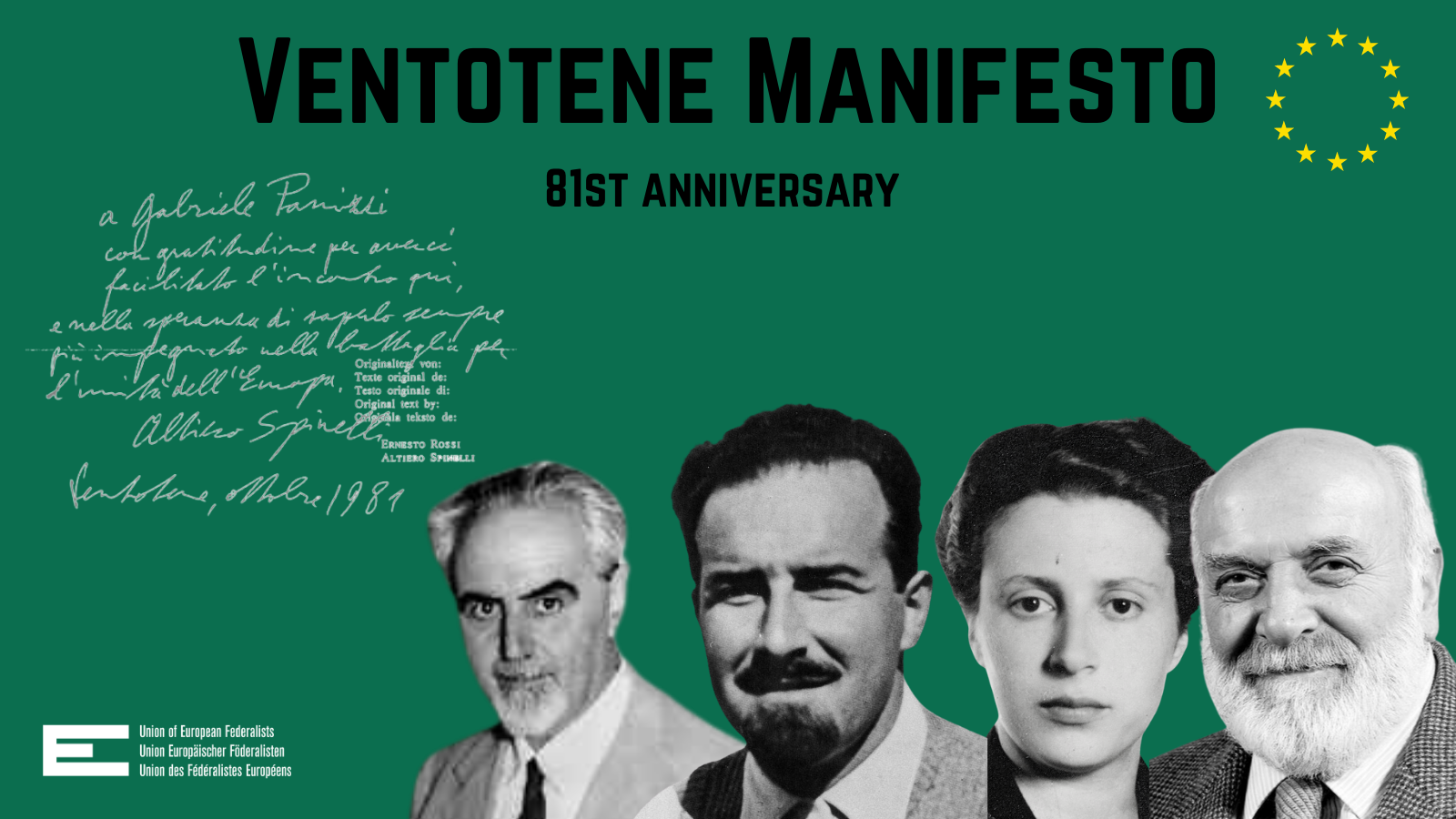
In 1941, while imprisoned on Ventotene island just off the coast of Italy, the intellectuals Altiero Spinelli, Ernesto Rossi and Eugenio Colorni penned ‘For a Free and United Europe’, a founding text urging for the creation of a united Europe built on federalist principles. This document, also known as the Ventotene Manifesto, was distributed among the European resistance thanks to Ursula Hirschmann, a German anti-fascist activist who managed to smuggle it from the island. In January 1944, a mimeographed clandestine edition of the Manifesto appeared in Rome.
All they had the courage, the imagination, and the irreverent genius to look up beyond the horizon of the present moment. They had the courage to imagine Europe and a future world in which civil rights and fraternity among all people would be at the center of social life and politics.
Back then, the authors of the Ventotene Manifesto called for “new people” to realise a free and united Europe, but, after 81 years, it is still an ongoing process to build a European identity united in shared values and solidarity through the founding of a political union of the 27 member states. Elements of this are visible, as in the unity that has been demonstrated during the COVID crisis.
We must now take advantage of the Conference on the Future of Europe, which was launched on 9 May 2021 in Strasbourg with civil society and citizens, in order to move forward a more sovereign, democratic and stronger EU. We expect, and as UEF are committed to, in particular, the start of a further deepening of the European Union and its transformation into a true European federation.
On the 81 Anniversary of the Ventotene Manifesto, we, the federalists, want to revive the Ventotene legacy and its spirit building a united Europe of freedom, equality and human rights in which each and every one of us can say “I belong”.” As stated in the last line of the Ventotene Manifesto, the road won’t be easy, but UEF will keep striving to develop Spinelli’s ideas.
“We want the CoFoE to open up a new phase, a phase of participation, but also of change. To change the rules, because we have seen in this year and a half that there cannot be taboos. European democracy must be more efficient and effective.” – EP President SASSOLI
THE TIME IS NOW, UEF’s fortnightly newsletter on the Conference on the Future of Europe! Issue 1/2022
Learn more about the Conference’s latest news and activities related to rebuilding the EU!
1. Citizens’ panel proposals on climate change, environment and health
Citizens proposed ways to improve health, fight climate change and protect the environment at a forum held in Warsaw on 7-9 January.
As part of the Conference on the Future of Europe, Warsaw hosted some 200 Europeans on 7-9 January 2022, who came for the third and final session of the European citizens’ panel dedicated to climate change, environment and health. Due to the current Covid-19 situation, some panel members joined remotely.
Panellists discussed their recommendations in five areas:
Better ways of living
Protecting our environment and our health
Redirecting our economy
Redirecting overproduction and overconsumption
Caring for all
Participants voted on 64 recommendations: 51 were approved, while 13 did not reach the required 70% support threshold.
2. The citizen’s proposal for transnational lists divides MEPs
The proposal to establish transnational lists for the elections to the European Parliament, divided last Wednesday the MEPs who analyzed the citizen recommendations of the CoFoE.
The citizens set in their conclusions the desire for an election to the Parliament, where voters could vote for different parties of European level, including candidates from several Member States.
Guy Verhofstadt, saw behind this point a demand to implement transnational lists. However, the EPP MEP Paulo Rangel accused Verhofstadt of carrying out “an abusive interpretation” of the citizen recommendations, since, according to him, the conclusions of the CoFoE do not explicitly mention the pan-European lists.
On the other hand, Renew, Greens and Social Democrats were in favor of moving towards the pan-European lists and, in addition, UEF Vice-President and S&D MEP Domènec Ruiz Devesa also valued very positively the proposal to reopen the debate on the European Constitution, set in the conclusions of the CoFoE citizen panels.
This EPRS publication seeks to put into context and offer insights on 10 key issues and policy areas that have the potential to feature prominently in public debate and on the political agenda of the European Union in 2022. Issue number 8 talks about the outcomes of the CoFoE.
If Treaty change is not on the horizon in the short term, then a scenario of ‘soft’ reforms could be considered, whereby some changes could be introduced by leveraging the full potential of the current Treaties. This would mean exploring the unused potential of the Treaties in several fields, from overcoming unanimity through qualified majority voting, using passerelle clauses to strengthen the EU dimension of European elections, or improving decision-making on the common foreign and security policy. In this respect, Parliament has already contributed in 2017 with a resolution offering a useful starting point, proposing for instance to limit the intergovernmental approach, make more frequent use of its own right of legislative initiative, reduce the number of Council configurations, and transform Council into a genuine legislative chamber. A mechanism to follow up on the conference’s conclusions is also a possibility, in order to bring in ‘soft’ reforms.
One possible innovation is the introduction of a permanent participatory mechanism to involve citizens in EU decision-making beyond the traditional electoral period.
4. What’s Next?
The recommendations of the European Citizens’ Panels will be presented and discussed at the Conference Plenary, where the Conference’s final proposals will continue to be shaped.
The next Conference Plenary is set to take place on 21-22 January in Strasbourg. In the meantime, the Plenary Working Groups met on Friday 17 December in remote format to continue their preparatory work. Citizens across Europe can also continue to take part in the Conference through the Multilingual Digital Platform.
The remaining European Citizens’ Panels will also be adopting their recommendations in the near future, in the following areas:
Panel 1 – A stronger economy, social justice and jobs / Education, culture, youth, sport / Digital transformation (to be held in Dublin, Ireland)
Panel 4 – EU in the world / Migration (to be held in Maastricht, The Netherlands).
In the recent years there has been much talk about the erosion of liberal democracy, which has been manifested in various disturbing developments: from decreasing trust of citizens in the institutions of representative democracy and decreasing voter turnout to the growing political and societal polarization and the rise of the populist radical Right that promotes ethnic nationalism and attacks civil rights and individual liberties. In general, these developments have often been portrayed as signs of citizens’ dissatisfaction with democracy. – Filip Milacic is a senior researcher at the Friedrich Ebert Stiftung’s office for “The Democracy of the Future” in Vienna.
Taking into consideration the crises that the European Union has been through in the last decade, it’s obvious that the dialogue concerning its future is more than required. In any case, such a process shall now include the “voices” and concerns of the EU citizens and not just be a product of the EU institutions and member states. – Angelanna Andreou, Lefteris Vasilopoulos and Pinelopi Katsigianni are members of JEF Piraeus-Athens.
Responding to the democratic crisis is just as important as tackling the climate emergency. This is why we fought for the Conference on the Future of Europe, despite the reluctance of those who fear consulting citizens on the European issue, write Guy Verhofstadt and Pascal Durand. – Guy Verhofstadt and Pascal Durand are members of the European Parliament for the Renew Europe group.
The CoFoE could be the beginning of a process that values the creation of democratic citizen-centric ecosystems, inhabited by participatory processes increasing participants’ sense of efficacy in politics while addressing the most intractable issues of our times. In this new paper written by Alberto Alemanno and Kalypso Nicolaidis they explain why.
Protection of the rule of law in Europe requires going beyond what we already have in the EU rule of law toolbox and beyond merely Brussels. We need to expand and improve. We should start with listening to what people who live in the EU have to say. The recent European Citizen’s Panel ‘European democracy / Values and rights, rule of law, security’ organised as part of the Conference on the Future of Europe proposed two excellent recommendations.
Conditions for the success of the operation are the electoral victory of Macron, the permanence of Draghi at Palazzo Chigi, and their triangulation with Scholz
At the first meeting of EU ambassadors of the New Year, the CoFoE was not even on the agenda. As France currently holds the EU presidency and CoFoE was the brainchild of President Emmanuel Macron this was a surprising omission.
As we enter 2022, it is 30 years since Citizenship of the EU was first introduced during the Maastricht Treaty negotiations. This led to the creation of the first transnational citizenship, affording all EU citizens with rights, freedoms and legal protections, write Suzana Carp and Justin Goshorn.
The Conference on the Future of Europe is a chance to address the most prominent issues in Europe’s regions and translate them into proposals for the future of the bloc, regional stakeholders say.
The success of the Conference on the Future of Europe (CoFoE) depends on the geographical spread and depth of the debate and proper follow-up, EU stakeholders warn.
European Parliament (EP) President David SASSOLI has passed away at age 65.
Born in Florence on 30 May 1956, SASSOLI studied political science before starting work as a newspaper and news agency journalist.
The father of two began working for national broadcaster RAI in 1992, rising through the ranks to become a familiar face for millions of Italians, presenting the evening news on the main channel, of which he also became deputy-director.
Mr. SASSOLI, a member of Italy’s center-left Democratic Party, has been a member of the EP since 2009. He was elected vice president five years later and has led the body since 2019.
As Parliament President, SASSOLI was a largely conciliatory voice, working to help advance the agenda of von der Leyen, the Commission’s first woman President, including the European Green Deal, the ambitious package of measures to combat climate change.
During his mandate SASSOLI called for a new “political pact” with other institutions to give shape and content to the request of a new Europe, improving the Spitzenkandidat process, enhancing the Parliament’s voice and powers and enacting reforms and treaty revision to strengthen European democracy.
“We want the Conference on the Future of Europe (CoFoE) to open up a new phase, a phase of participation, but also of change. To change the rules, because we have seen in this year and a half that there cannot be taboos. European democracy must be more efficient and effective. The European Parliament is very ambitious on this.”, said the EP President SASSOLI at the European Youth Event in the framework of the CoFoE.
As a committed European, he always believed that our future lies in a democratic and sovereign Europe, and pushed for a new European democratic transformation.
In 2020, Sandro GOZI, MEP for Renew Europe and President of the Union of European Federalist (UEF), handed over the nearly 1,200 signatures of the ‘1,000 x Federal Europe‘ campaign to David SASSOLI. With President SASSOLI, we shared the need and urgency to provide the Union with new genuine own resources for the European revival.
That same year, the UEF sent an open letter to MEPs calling on the EP to propose the required amendment to the Treaties and asking the other EU institutions to commence the related process of treaty revision. The EP President thanked UEF for the commitment to the European project, he stressed on the need to have a successful CoFoE and on the key role that the Parliament, Civil Society and European Youth has on it.
“UEF is deeply saddened by the terrible loss of a great European and an outstanding President of the European Parliament. He has been a member of the Movimiento Federalista Europeo in Rome, since Mr. SASSOLI was a convinced federalist, a champion of European democracy, values and integration. We commend his efforts to build a strong house of European democracy, and express our sincere condolences to his family, friends, and colleagues. Riposa in pace.”, said UEF President and MEP Sandro GOZI.
UEF-President Sandro GOZI: “We must show the same courage and the same determination of our founders and push for a new European democratic transformation.”
These days, the Union of European Federalists (UEF) celebrates its 75th anniversary! It marks 75 years of bringing together generations of passionate European federalists who, since the end of World War II, have been campaigning for a united and federal Europe.
The organisation was founded in Paris on 15 and 16 December 1946 based on the conviction that peace for future generations could only be secured by the formation of a European federation. The driving idea “unity in diversity” was the basis on which European federalists thought the division of the European continent, that had caused the suffering and destruction of the two World Wars, could be overcome.
The European federalists are still convinced today that only a common effort made by citizens working towards this goal could and can create a peaceful and democratic Europe that guarantees freedom and human rights. At the Congress of Europe in The Hague in 1948, the federalists had an opportunity to reshape the Europe of their time. Back then, federalists fought to put over their vision on the future of Europe, and important federalist elements were also agreed – such as the decision to draw up a binding Charter of Fundamental Human Rights and to establish a supranational Human Rights Court.
The UEF became a leading voice in the European unification process and from the outset advocated for the strengthening of the European Communities, later the European Union. The main goals of the European federalists included the abolition of borders between European States, the introduction of a European currency, direct elections as well as the institutional strengthening of the European Parliament, the introduction of majority decisions in the Council of Ministers, the adoption of European fundamental and human rights and the reinforcement of European foreign and security policy. All these goals have been at least partially achieved in recent years.
On top of the ideas mentioned above, the realisation of a constitution that would lead to a European federal state is the European federalists’ key call. However, this has not been still achieved. The process of constitutionalising the European Union was essentially set in motion by Altiero Spinelli in 1984 with the so-called “Spinelli Treaty”. This led to a revision of the Treaties and served as a basis for the European Community and the Constitutional Treaty later on.
Today, the UEF’s work for a further deepening of the European Union and its transformation into a true European federation continues through the Conference on the Future of Europe (CoFoE). The Conference provides all citizens, and especially the younger generations, with the unique opportunity to make their voice heard and to advocate for the Europe they want by shaping it with their ideas. As European federalists, we must be the leading voice calling for a united and federal Europe.
The CoFoE is particularly special for UEF. For the first time in its 75 years of existence, the UEF has taken a seat at the conference table and can directly feed the political decision- making process with its positions. UEF is part of the delegation of the European Movement International (EMI) in the organised civil society group. It is represented by its Secretary General Anna Echterhoff. With President and MEP Sandro GOZI and Vice-President and MEP Domènec RUIZ DEVESA in the group of MEPs, the UEF is represented with three voices in total.
“Federalism means respect of national and regional identities, promotion of political pluralism, efficiency of the public action, transnational politics and it is a multiplier of rights and opportunities for all. 75 years after, we must show the same courage and the same determination of our founders and push for a new European democratic transformation: we will never give up on this”, underlines President and MEP Sandro GOZI.
Thus, the UEF has the historic opportunity to lead the debate on the reform of the Union towards a democratic, federal entity that is close to citizens and can ensure the protection and promotion of our values. Recent developments show that a stronger pro-European sentiment is emerging in several Member States, which politically strengthens the work of the Conference itself. The UEF will continue to be the driving force for change by communicating its ideas and proposals and fueling the discussions with solutions to strengthen the European Union. For 75 years, UEF has put itself to the service of the European unification and it will continue to do so.
UEF 75th anniversary with UEF President Sandro Gozi